
Thinner Lenses
Thinnest Glasses Lenses for High Prescription
At PW Optics, we are committed to offering eyewear solutions that are both stylish and practical. One key innovation in modern optics is the development of thinner lenses, ideal for individuals with higher prescriptions. Unlike standard plastic lenses, our thinner lenses are crafted from high-index materials, allowing for a sleek, flatter, and significantly lighter finish. This advanced design reduces the overall thickness, providing a more comfortable and aesthetically pleasing option for wearers.
Why Are Thinner Lenses Better?
Thinner lenses are particularly beneficial for several reasons:
- Enhanced Comfort: Standard lenses can be heavy and cumbersome, especially with stronger prescriptions. Thinner lenses significantly reduce the overall weight, making them more comfortable for all-day wear.
- Improved Aesthetics: Thinner lenses offer a more streamlined and elegant look. They help eliminate the “bug-eyed” appearance often associated with thicker lenses, allowing for a more fashionable and sophisticated eyewear experience.
- Reduced Distortion: High-index lenses minimize distortion, providing clearer vision across the entire lens surface. This is particularly important for those with higher prescriptions, as thicker lenses can lead to visual aberrations at the edges.
Do Thinner Lenses Make a Difference?
Absolutely! Thinner lenses can significantly improve the overall experience of wearing glasses, particularly for those with higher prescriptions. The benefits include:
- Weight Reduction: With thinner lenses, you can enjoy a lighter and more comfortable fit, reducing the pressure on your nose and ears.
- Aesthetic Appeal: Thinner lenses create a more refined look, making your eyewear more fashionable and less bulky.
- Improved Vision: High-index lenses provide superior optical clarity and reduce the visual distortions often associated with thicker lenses. This means clearer peripheral vision and a more natural viewing experience.

Do Thinner Lenses Cause More Distortion?
Contrary to some misconceptions, thinner lenses do not cause more distortion; in fact, they often reduce it. Thicker lenses can create visual distortions, especially for stronger prescriptions, due to the curvature and increased thickness at the edges. High-index thinner lenses, however, are designed to minimize these distortions:
- Less Edge Distortion: The flatter profile of high-index lenses helps reduce the amount of distortion experienced at the edges, providing clearer vision throughout the lens.
- Better Optical Performance: High-index materials are engineered to offer better refractive properties, allowing for clearer and more precise vision, even in higher prescriptions.
High Prescription Glasses in Stourbridge
How Much Thinner Are High-Index Lenses?
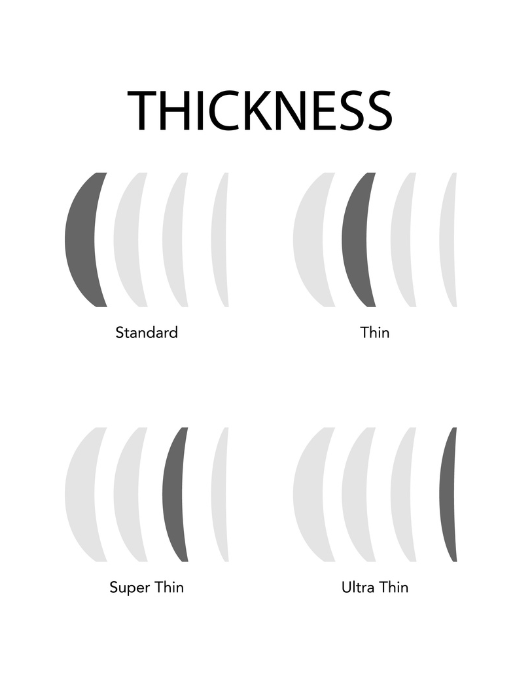
High-index lenses can be significantly thinner than standard plastic lenses, and at PW Optics, we offer three different levels:
-
Thin Lenses
-
Super Thin Lenses
-
Ultra Thin Lenses
The thickness reduction varies based on the index level:
- Standard Plastic Lenses: Typically range from 2.0 mm to 5.0 mm thick, depending on the prescription.
- High-Index Lenses:
- Thin Lenses: Offer a reduction of approximately 30% compared to standard lenses.
- Super Thin Lenses: Provide a thickness reduction of up to 40%.
- Ultra-Thin Lenses: Can be up to 50% thinner than standard options. For example, a lens can be reduced from approximately 5.0 mm to around 3.0 mm with an ultra-thin high-index lens.
What Prescription Needs Thinner Lenses?
Thinner lenses are especially recommended for individuals with higher prescriptions.
What is Considered a High Prescription for Glasses
A “high prescription” for glasses typically refers to stronger refractive errors that require significant lens curvature to correct vision. Here’s a general guideline for what is considered a high prescription:
For Myopia (Nearsightedness)
- Moderate Myopia: -3.00 diopters to -6.00 diopters
- High Myopia: Greater than -6.00 diopters
For Hyperopia (Farsightedness)
- Moderate Hyperopia: +2.00 diopters to +4.00 diopters
- High Hyperopia: Greater than +4.00 diopters
For Astigmatism
- Moderate Astigmatism: ±1.00 diopters to ±2.00 diopters
- High Astigmatism: Greater than ±2.00 diopters
Factors Influencing Prescription Consideration
- Combination of Errors: A combination of high myopia, hyperopia, and astigmatism can lead to a complex prescription, which may also be considered high.
- Visual Impact: Even if a prescription falls into a moderate range, it can be considered high if it significantly affects a person’s daily activities or requires specialized lenses for optimal vision.
Lens Options for High Prescriptions
Our thinner lenses are an excellent choice for individuals with stronger prescriptions. Traditional lenses can often be bulky and thick, particularly for higher prescriptions, which may cause discomfort and affect the appearance of the glasses. However, with our thinner lenses, these issues are eliminated, offering:
- A lighter weight for all-day comfort.
- A flatter profile, ensuring a more subtle and refined look.
- Improved visual clarity, with reduced distortion at the edges.
Available in Multiple Index Levels
We offer our thinner lenses in three different index levels, catering to various prescription needs. Whether your prescription is moderately strong or requires a more tailored approach, we have the perfect solution for you. Each of these lenses comes with an anti-glare coating as standard, ensuring enhanced visual comfort by reducing reflections from screens, headlights, and other light sources.